

How Recent U.S. Tariffs Are Impacting the Industrial Automation Sector
11 April, 2025 | Tariffs, Bosch Rexroth Indramat, Wake Industrial, Automation, China, China Tariffs, US Tariffs, Canada, Mexico
How Recent U.S. Tariffs Are Impacting the Industrial Automation Sector
UPDATE: As of 4/29/25 The US has provided some relief to us Auto Manufacturers with a revised tariff policy
UPDATE: As of 5/12/25 The US has has reduced Tariffs on most Chinese products from 145% to 30% and China has cut down Tariffs on US goods from 125% to 10% for the next 90 days. During the next 90 days both countries will continue to discuss potential trade deals.
UPDATE: As of 5/21/25 Tensions have risen again as the US states that anyone using semiconductor chips from Huawei Technologies violates US export controls. China has threatened legal action to anyway enforcing the US restrticion.
Recent shifts in U.S. tariffs on automation technologies are reverberating across the industrial automation sector, affecting everything from supply chain costs to project timelines. In 2024 and 2025, trade policy changes have introduced new import duties on a wide range of equipment and components. These tariff effects on manufacturing are raising prices for critical hardware and materials, forcing companies to rethink sourcing strategies. This analysis explores how the evolving tariff landscape influences import/export dynamics for automation equipment, what it means for engineers, business owners, and plant operators, and how global players like Bosch Rexroth fit into the picture.
Sources for resale and refurbishment have gained value overnight, as they offer a business positive solution for sourcing quality, effective products. Wake Industrial is a leading supplier of automation solutions, specializing in motors, drives, encoders, PLC, and more–use the form above to receive a quote within 15 minutes during business hours. If you would like to speak with a representative, call 1-919-443-0207.
Tariffs Reshaping the Import/Export Landscape for Automation
Recent U.S. tariff changes have significantly altered the import/export landscape for industrial automation equipment. The Office of the U.S. Trade Representative and White House have rolled out several new duties aimed at a broad swath of trading partners. As of early 2025, the United States has implemented a universal baseline tariff of 10% on virtually all imports. This across-the-board tariff, effective April 2025, is layered on top of existing duties and targeted measures. In addition, some of America’s largest trading partners face even higher tariffs on certain goods:
China:
U.S. tariffs on Chinese imports have been ratcheted up. An additional 10% tariff on Chinese goods took effect in late 2024, on top of the pre-existing Section 301 tariffs (which were already around 25% on many industrial items). Certain high-tech and industrial products from China now carry dramatically higher rates – for example, tariffs on semiconductor imports doubled from 25% to 50% by 2025, and tariffs on EVs jumped to 100%. These moves aim to protect U.S. technology and manufacturing but have made importing Chinese automation components far more expensive.
North American Neighbors:
In a break from past practice under free trade agreements, the U.S. announced 25% tariffs on imports from Mexico and Canada in 2025. This is a significant shift, as North American supply chains for manufacturing (including automation hardware like sensors, wiring, and assembly equipment) had been largely tariff-free under USMCA/NAFTA. The new tariffs threaten to erode the cost advantages of nearshoring production in Mexico or Canada. For example, a U.S. factory importing a machine module or robotic part from a supplier in Mexico now faces a 25% cost uptick purely from tariffs. Likewise, Canadian-made industrial equipment has become pricier for U.S. buyers.
Europe and Asia:
While U.S. tariff policy has particularly targeted China, it has also cast a wide net globally. Dozens of countries are facing new “reciprocal” tariffs. European industrial exporters – for instance, Germany, a major source of advanced factory machinery – are not exempt. A baseline 10% import tax now applies to European-made automation products entering the U.S.. Additionally, sector-specific duties hit some European goods. For example, a 25% U.S. tariff on imported automobiles and parts indirectly affects robotics and automation firms that supply the automotive industry. In Asia beyond China, key tech-manufacturing hubs like Japan, South Korea, and Taiwan are also caught in the tariff crossfire. Many electronics, robots, and machine components from these countries now incur U.S. tariffs.
These tariff changes have reshaped import costs and export dynamics for automation technology. Imported robots, drives, sensors, and raw materials now cost more when coming into the U.S. market. For example, industrial-grade steel and aluminum – essential for building machinery frames, robot arms, and equipment casings – are subject to higher tariffs raised to 25% in many cases. That directly increases the price of imported machine frames and components made of those metals. Likewise, a U.S. company buying a PLC or servo motor from overseas must budget for new tariff costs. On the export side, American automation companies face the risk of foreign retaliatory tariffs, which can make U.S.-made industrial products less competitive abroad. The net effect is a more complex trade environment, where sourcing decisions and supply chains for automation are in flux.
Crucially, the tariff landscape is evolving. Policy uncertainty remains about how long these tariffs will last or if they will change with ongoing negotiations. However, businesses in the automation sector cannot afford to wait – they are already feeling the impact and are adapting in real time to this new trade reality.
Rising Costs for Automation Equipment and Components
The immediate consequence of new tariffs is higher costs for imported automation equipment. Tariffs function like a tax on imports, and in practice these costs are often passed along to U.S. buyers. In the machinery and industrial equipment sector, profit margins are tight and competition is global, so any tariff-induced cost hike is significant. Key cost impacts include:
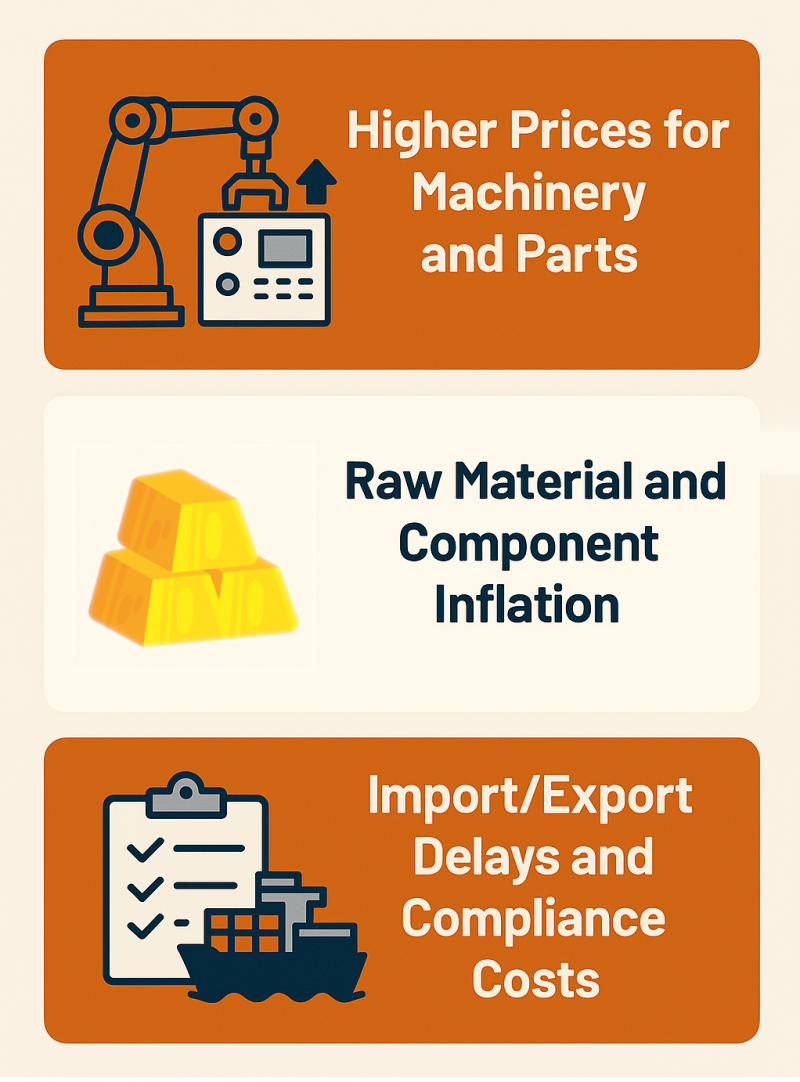
- Higher Prices for Machinery and Parts: Many factories rely on imported machines, robots, and spare parts to automate their operations. With tariffs, the price tags on these imports have climbed. For instance, U.S. manufacturers sourcing precision gears, hydraulic systems, or control modules from China have seen substantial cost increases. An American integrator importing an industrial robot from Japan or a servo drive from Germany now must pay the added U.S. duty on top of the base price. These increases can range from 10% extra to as high as 30+% depending on the item’s country of origin and category. Such cost inflation is squeezing budgets for automation projects.
- Raw Material and Component Inflation: Automation equipment isn’t just finished machines it's also built from countless components and raw materials. Tariffs on steel and aluminum (now 25% on many imports) are raising the cost for domestic production of automation equipment, since U.S. manufacturers of robots or conveyors must pay more for metal inputs. Electronic components like semiconductors and circuit boards are also impacted; a 50% tariff on imported semiconductors from China means any control panel or industrial computer that relies on those chips will carry a higher bill of materials. Even specialized items such as a machine vision camera imported from Europe or a sensor from Canada have new tariff costs attached. These increases accumulate across the Bill of Materials of an automation system, ultimately driving up the price of automation implementations for end users.
- Import/Export Delays and Compliance Costs: Beyond direct costs, tariffs add bureaucracy and potential delays. Importers must classify goods correctly and navigate exclusion processes or customs procedures to handle the tariffs. There’s also the end of the de minimis exemption for small shipments from China, meaning even low-value spare parts that used to come in duty-free now incur fees. These factors complicate the import process, sometimes causing delays at ports or the need for additional paperwork. Creating an extra headache for plant maintenance teams awaiting critical parts. Some firms report needing more warehouse space to stockpile parts ahead of tariff implementation dates, tying up capital in inventory.
It’s worth noting that these rising costs ultimately affect the ROI for automation. When automated systems become more expensive to import or build, the business case for automation can weaken, potentially slowing the pace at which companies adopt new automation methods especially for smaller manufacturers sensitive to price swings.
However, demand for productivity gains and shortage of skilled labor in manufacturing continue to drive automation forward, tariffs notwithstanding. Thus, companies are seeking ways to adapt rather than abandon automation. We will discuss mitigation strategies and adaptations shortly, but first, let’s examine how these tariffs specifically impact various stakeholders in the industrial automation ecosystem.
Implications for Engineers, Business Owners, and Plant Operators
Tariff turbulence is being felt on the factory floor and in corporate strategy rooms alike. Engineers, business owners, and plant operators. Each of these roles experiences the impact in different ways:
Engineers and Procurement Teams:
Engineers responsible for specifying and sourcing equipment now must factor tariffs into their decisions. The components they design into a system might suddenly carry a hefty import duty. For example, an engineer planning an upgrade with new robotic arms might discover that models from overseas suppliers are no longer cost-competitive due to tariffs. This can lead engineers to redesign systems around more readily available or domestically produced components. In some cases, engineers are working closely with procurement to find alternate suppliers in countries not subject to tariffs or to qualify second-source components. They also face longer lead times if suppliers shift production. In short, engineers must be agile in their designs and component choices to balance performance needs with the new cost realities. Technical teams are even considering “tariff engineering”, tweaking product configurations or assembly locations to qualify for lower duties. For example, importing subcomponents and doing final assembly in the U.S. or another country.
Business Owners and Supply Chain Managers:
For company owners and executives, tariffs hit directly at the bottom line. Higher import costs can squeeze profit margins, unless those costs can be passed to customers. Business owners are therefore in a tough spot – absorb the costs and reduce margins, or raise prices and risk losing business. Many are also concerned about reciprocal tariffs: foreign governments may retaliate with tariffs on U.S. exports, potentially hurting sales abroad. Supply chain and operations managers are scrambling to reconfigure supply chains to mitigate these risks. Strategies include increasing inventory before tariff hikes, and shifting sourcing to alternative countries. There’s growing interest in sourcing from Southeast Asian countries like Vietnam, India, or Indonesia, which are not yet facing the same level of U.S. tariffs. Some companies are also evaluating bringing production back to the U.S.
Plant Operators and Maintenance Teams:
On the factory floor, those who keep the automation systems running face practical challenges from tariffs. Spare parts for robots and production machinery, often ordered as-needed from overseas, now come with added costs and possible delays. Maintenance managers may find that a replacement drive or circuit board that used to cost $1,000 now effectively costs $1,200+ after tariffs and fees. This can blow out MRO budgets. In some cases, plant operators might delay non-critical repairs or stretch the life of equipment longer to defer costly imports. There is also a greater incentive to buy refurbished or second-hand parts that are already in the U.S. We see more interest in the secondary market for industrial automation components, companies like Wake Industrial and others selling refurbished Bosch Rexroth Indramat drives from U.S. inventory. Operators also worry about reliability: if a machine is down and the needed part is tied up in customs due to tariff paperwork, that means extended downtime. Thus, operational risk has increased, and many plants are boosting on-site inventories of critical spares to hedge against supply disruptions. Overall, plant personnel are being forced to plan further ahead and coordinate closely with supply chain teams to ensure that tariff issues do not halt production.
In summary, the tariff surge is causing engineers to re-engineer, executives to re-strategize, and operators to re-adjust their maintenance and stocking practices. Every stakeholder in the automation value chain must stay nimble and informed. Next we'll explore which countries and tariffs are having the most effect on the automation industry, followed by a closer look at a specific example: Bosch Rexroth Indramat motors and drives.
Global Tariff Hotspots Affecting the Automation Industry
It’s important to understand which countries’ tariff policies are most impacting the automation industry. U.S. tariff actions are the primary driver here, effectively targeting multiple regions.
China – Trade War Tariffs on Technology:
China remains front-and-center in the tariff discussion. The U.S.-China trade war, ongoing since 2018, entered a new phase after a four-year review. By 2024, the USTR not only maintained the Section 301 tariffs on roughly $370 billion of Chinese goods, but started raising rates on strategically important imports. This disproportionately affects the automation sector because China is a huge source of affordable industrial components and electronics. With tariffs, many of these Chinese products now face total duty rates of 25–35%, and certain items much higher. For instance, as noted, semiconductor components vital to automation are tariffed at 50% when imported from China. Likewise, industrial electrical components and machinery parts from China commonly face 25% tariffs. Given China’s role as the world’s manufacturing hub, these tariffs are arguably the most impactful, driving companies to seek non-Chinese suppliers despite China’s cost advantages. China has retaliated with its own tariffs on U.S. exports in past years, but since the U.S. imports far more from China than vice-versa, the pressure is felt more acutely on the import side. In sum, U.S. tariffs on China represent a major cost driver in the automation industry today, influencing prices of everything from drive controllers to assembly robots.
Mexico & Canada – Erosion of Tariff-Free Zones:
Historically, one of the benefits for U.S. manufacturers was the integrated North American supply chain, thanks to free trade agreements. Automation integrators often source parts from Mexico which has a strong automotive and electronics manufacturing base or Canada. However, the new U.S. tariffs on Mexico and Canada are a game-changer. Suddenly, a robot assembled in Mexico or a control panel built in Canada carries the same kind of tariff as if it came from overseas. This broadens the impact of tariffs to virtually all geographic directions. Companies that “nearshored” production to Mexico to avoid China tariffs are now getting caught by this tariff extension. The impact is significant because Canada and Mexico are among the U.S.’s largest trading partners for industrial goods. The tariffs are already prompting tough conversations: Mexican officials and industries are alarmed, and some U.S. firms are re-evaluating the viability of expansion in Mexico if those products will be tariffed on entry to the U.S. For Canada, sectors like industrial machinery and automotive parts are directly hit. Thus, North American tariffs have quickly become as impactful as the China tariffs in certain industries, essentially eliminating the safe harbor of tariff-free sourcing in the region.
Europe – Tariffs on Machinery and More:
The European Union, and Germany in particular, is known for high-end industrial automation products – think Siemens controls, Bosch Rexroth hydraulics, ABB (though Swiss/Swedish), and more. Under recent U.S. policy, European exports are facing new tariffs as well. While early 2025 “reciprocal tariffs” spared Canada/Mexico initially, Europe was among the regions targeted for higher duties. For example, automotive tariffs at 25% affect European carmakers and by extension the robotics and automation companies that supply those factories. A report from ABN AMRO projected that a broad 25% U.S. tariff on EU goods could even tip the eurozone into a mild recession, highlighting how serious the trade implications are. Specifically for automation, U.S. importers of European machine tools, robotics, and electronics now pay roughly 10% extra by default and possibly more if the product falls under a targeted category like machinery or electronics. European countries also have imposed their own tariffs on U.S. goods in certain disputes. For instance, the EU answered earlier U.S. steel tariffs with tariffs on U.S. products like machinery, motorcycles, etc., but a truce was reached on some of those in 2021. Still, as of 2024–2025, the EU–U.S. trade relationship is strained by new U.S. tariffs, making European automation equipment less competitive in the U.S. market. This is pushing American buyers either toward domestic or other sources, or to swallow the extra cost for top-tier European technology.
Other Asian Sources (Japan, South Korea, Taiwan, etc.):
The U.S. tariffs do not explicitly single out U.S. allies in Asia, but the “all imports” baseline means countries like Japan and South Korea are indirectly hit. Japan is a key supplier of industrial robots and machine tools, while South Korea and Taiwan supply numerous electronics and factory equipment. Under the new policy, a Japanese robot imported to the U.S. now faces the 10% duty and possibly more if classified under any specific electronics tariff category. A Reuters analysis noted that even IBM products assembled in Japan, Mexico, or China are all being hit hard by the new tariffs. So, Asian high-tech imports are seeing increased landed costs in the U.S., which affects everything from servo motors to PLCs. It’s worth noting, too, that U.S. export controls (separate from tariffs) on certain tech to China have led Chinese firms to favor Japanese and European automation solutions, which could shift some competitive dynamics. In essence, major manufacturing economies across Asia are part of the U.S. tariff net, making this a truly global trade shift.
Overall, the countries currently exerting the most tariff impact on automation are those entangled with U.S. trade measures: China due to high-tech and volume of trade, the NAFTA partners because he abrupt tariff imposition on close-to-home supply lines, and the advanced industrial nations like Germany/Japan with their role in supplying advanced equipment. Each of these is contributing to higher costs and strategic adjustments in the automation sector. No single country dominates the narrative entirely, rather, it’s the combination of tariffs on multiple fronts that creates a compounded challenge.
Bosch Rexroth Indramat Amid Tariffs
In discussing real-world implications, Bosch Rexroth provides a concrete example of how tariffs intersect with the automation industry. Bosch Rexroth, a German-based engineering company, produces a range of industrial automation components, and its Indramat line is famous for servo motors, drives, and motion control systems found in countless manufacturing plants. Here’s how Indramat motors and drives fit into the tariff-affected import picture:
Dependence on Global Supply:
Indramat products are designed and made primarily in Germany and other Bosch Rexroth facilities in Europe. U.S. factories often import these motors and drives to keep their machines running. For example, a packaging plant in the U.S. might use Indramat servo motors on its conveyor system, or an automotive factory might use Indramat drive controllers in its assembly robots. Under normal conditions, these parts would enter the U.S. with minimal import duty (Germany being an MFN trading partner). However, with the recent U.S. tariffs, Indramat products now incur additional import costs. If classified under industrial machinery parts, they may face the baseline 10% tariff on EU goods. If any specific tariffs on electronics or mechanical components apply, the rate could be higher. Some industrial electrical components from Europe might face 15–20% total duty when various measures are combined. The result: a replacement Indramat motor that cost $5,000 might now cost $5,500+ after tariffs, shipping, and customs fees. This directly impacts maintenance budgets for plants that rely on these foreign-made parts.
Impact on Maintenance and Upgrades:
Many Bosch Rexroth Indramat units are used as replacement parts or retrofits in older machinery. When a drive fails on a production line, the plant often must import a new or reconditioned unit quickly to avoid downtime. Tariffs have effectively made these emergency imports pricier and potentially slower due to customs clearance. Some U.S. distributors and third-party resellers anticipated this: companies like Wake Industrial carry refurbished Indramat drives and motors in the U.S. to sell to domestic customers, partly so that buyers can avoid the hassle of importing on short notice. When searching for a refurbished Indramat drive or motor, Wake Industrial offers a reliable and hassle-free solution thanks to a large inventory of obsolete and current products. Get the part you need quickly by calling 1-919-443-0207 or using our convenient online quote form. This secondary market has become more attractive as tariffs add cost to buying direct from Germany. Plant operators now weigh options: pay a premium for a new Indramat drive imported from Europe, or purchase a refurbished unit from a U.S. supplier. In this way, tariffs might unintentionally boost the market for refurbished automation components. However, not every scenario has a domestic workaround, so many businesses simply have to budget more for Indramat parts and accept the cost when needed.
Manufacturer’s Response:
Bosch Rexroth as a company has been responding to global trends, including trade tensions. In 2023, Bosch Rexroth saw strong sales growth but also a decline in new orders due to economic downturns in major markets. Trade uncertainty likely played a role in that downturn. To mitigate risks and better serve regional markets, Bosch Rexroth has invested in a global manufacturing network, including a new plant in Querétaro, Mexico. By expanding production to Mexico and other locations, Bosch Rexroth can manufacture closer to the U.S. market, potentially bypassing some tariffs. Indeed, the press release announcing the Mexico plant highlighted the goal to “strengthen and balance the global manufacturing network and consolidate local supply chains.” This suggests a strategy to hedge against trade barriers by localizing production. However, as noted, the new U.S. tariffs on Mexico complicate this strategy, if those remain, even Mexican-made Bosch Rexroth products could face tariffs entering the U.S. Nevertheless, having a footprint in North America might allow Bosch Rexroth to lobby for exemptions or use the regional content rules to its advantage. It’s a cat-and-mouse game between policy and corporate strategy.
Broader Picture for Similar Products:
Bosch Rexroth Indramat is just one example; many other foreign automation suppliers are in the same boat. Japanese servo motors like those from Sanyo Denki or Okuma, Italian gearboxes, and British machine vision systems all are subject to the new import cost structure. What’s notable about Indramat and similar products is that they are often high-value, mission-critical components. Customers may have no choice but to import that specific part due to compatibility or performance needs, so they end up paying the tariff. Over time, if tariffs persist, we may see more domestic alternatives emerge. For instance, U.S. companies might start producing more of their own servo motors or drives to capture market share from imported ones, much like Nvidia and other chip companies are investing in U.S. manufacturing in response to tariffs. For now, though, companies like Bosch Rexroth remain vital to the automation ecosystem, and their products exemplify how tariffs are an added hurdle for industrial maintenance and expansion projects.
In summary, Bosch Rexroth’s Indramat motors and drives illustrate the granular impact of tariffs: a German-made piece of automation tech, crucial to many U.S. industries, caught in the crossfire of trade policy. Businesses must account for added costs and maybe adjust sourcing while the manufacturer itself is adapting its global operations to navigate the new normal.
Mitigation Strategies and Outlook
The industrial automation sector is nothing if not innovative, and companies are actively seeking ways to mitigate the impact of tariffs. While tariffs pose challenges, they also spur creative responses and strategic shifts:
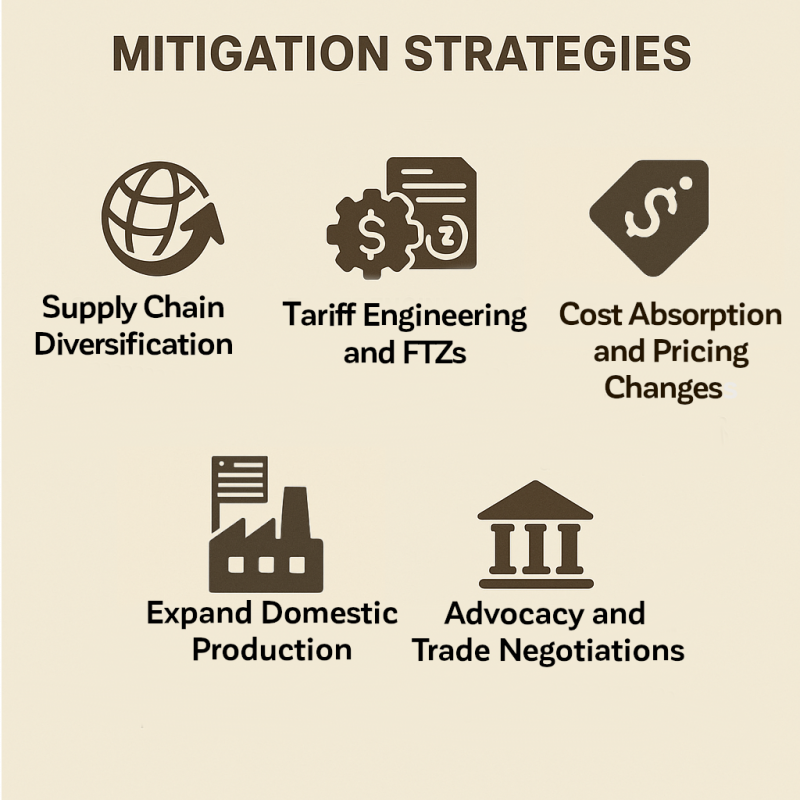
- Supply Chain Diversification: As mentioned, many firms are diversifying their supplier base. Instead of relying on one country (like China) for key components, they are qualifying suppliers in multiple countries. Some are turning to Southeast Asia, India, or Eastern Europe for alternative sourcing. Others are increasing orders from U.S. suppliers if available. This reduces exposure to any single tariff policy. However, diversification can increase complexity and isn’t immediate as building new supplier relationships takes time.
- Tariff Engineering and FTZs: Larger companies are employing tactics like tariff engineering – altering how a product is imported to reduce duties. One approach is using Foreign Trade Zones (FTZs) in the U.S.: importing components into an FTZ, assembling them there, and then formally “importing” the finished product, which can yield a lower effective tariff if the finished product has a different classification. For example, a manufacturer might import sub-components of an automation system under individual tariff codes, do final assembly in the FTZ, and then only pay duty on the assembled machine if that rate is lower. Some firms also explore slight modifications to products (changing a kit of parts vs. an assembled unit) to see if a different tariff code with a lower rate can be used – all within legal means.
- Cost Absorption and Pricing Changes: In the short term, many automation suppliers and integrators have had to absorb some of the tariff costs to stay competitive, accepting lower margins. Others have carefully raised prices or added surcharges to pass along costs to customers. It’s a delicate balance as too much of a price hike could stifle demand. Some end-users are understanding of moderate price increases given it’s a government-imposed cost, but there’s always pressure to minimize the impact. Contracts signed before tariffs took effect are being renegotiated in some cases to split the difference.
- Expand Domestic Production: Tariffs on imported automation tech are, by design, partially intended to encourage domestic manufacturing. We are indeed seeing an uptick in U.S.-based production investments. For example, semiconductor and electronics companies have announced interest in new U.S. factories. In the automation arena, we’ve seen companies have been expanding their U.S. production capacity for robots in recent years though for reasons including being closer to customers, not just tariffs. If more critical components can be made in the U.S., it provides a tariff-free source for domestic consumers. Of course, building local manufacturing takes time and significant capital, and not every component can be easily made domestically at competitive cost. But over a multi-year horizon, tariffs may gradually seed a more robust local ecosystem for automation hardware, but this is not a guarantee.
- Advocacy and Trade Negotiations: Industry groups and businesses are lobbying the government for relief or exclusions. In late 2024, many companies submitted comments to USTR about the harm of tariffs on imported machinery and components. There is an exclusion process for certain Chinese tariff categories (which had been active earlier in the trade war, granting temporary relief for specific parts that have no easy alternatives). Some automation companies successfully obtained exclusions in the past for specialized products, and they are pushing for renewed exclusions as tariffs increase. Diplomatically, U.S. allies like the EU and Japan are negotiating with the U.S. — for instance, the EU has floated a “zero-for-zero” industrial tariff deal eliminating tariffs on both sides for certain products. The outcome of such talks could ease the burden on automation imports if agreements are reached. However, as of 2025, the environment is still one of escalation, not relaxation, so companies are not banking on a policy reversal in the near term.
Looking ahead, the outlook for tariffs and industrial automation is mixed. On one hand, the current U.S. administration’s aggressive tariff stance is scheduled to continue, with some even set to increase in 2026. This suggests that companies should plan for an elevated tariff environment for at least the next couple of years. On the other hand, economic pressures like inflation and slower growth could prompt a re-evaluation of these policies. Tariffs have contributed to price increases. Analysts estimate the broad tariffs may raise U.S. prices by about 9.5% and shave roughly 1% off U.S. GDP. Such macroeconomic impacts might become hard to ignore. It’s possible that we could see adjustments or targeted relief if certain sectors including manufacturing suffer excessive pain.
What is clear is that tariffs are now a key factor in automation planning. Engineers, plant managers, and CEOs in manufacturing must stay informed on trade policy, almost as much as on technology trends, because the two are intertwined. The drive for efficiency and innovation in the industrial automation sector is as strong as ever. Companies know they need to automate to remain globally competitive and deal with labor challenges. Tariffs are a headwind, but not a total roadblock. We see firms adjusting rather than canceling automation initiatives. In many cases, the long-term gains from automation still outweigh the added upfront costs imposed by tariffs, though the calculus is tougher.
Conclusion
In conclusion, recent U.S. tariff changes are undeniably reshaping the industrial automation landscape. They are influencing the import/export environment by making automation technologies and equipment more expensive to trade. The implications for stakeholders are significant: engineers are redesigning systems around tariff costs, business owners are juggling supply chain shifts and margin pressures, and plant operators are managing practical challenges in keeping machines running amid costlier parts. The tariffs from multiple countries collectively create a more expensive and complex backdrop for the automation industry.
Yet, the industrial automation sector is meeting these challenges with characteristic resilience. Companies are deploying strategies to mitigate tariff effects: diversifying suppliers, localizing production, leveraging trade zones, and investing in domestic manufacturing. Over time, these adaptations may reduce dependency on tariffed imports and even bolster local industry. In the short term, however, many automation projects and operations are bearing higher costs and navigating uncertainty.
Finally, while this article has focused on the neutral analysis of impacts, it’s worth noting the bigger picture: tariff policies are a double-edged sword. They aim to protect and revive certain domestic industries, but they also raise input costs and can inadvertently slow down the very manufacturing renaissance they seek to spur. The automation industry sits at this crossroads: increased costs in the short run versus potential long-term adjustments that could strengthen local supply chains. How this balance plays out will be closely watched in 2025 and beyond.
Sourcing high quality, durable products will continue to be an effective strategy in mitigating the rising cost of manufacturing and maintaining a product line. Wake Industrial is your partner in progress–sourcing many new, obsolete, and legacy parts to keep your business running. These include, but are not limited to motors, drives, controllers, and PLCs. Our expert technicians offer rapid repair services for all Bosch Rexroth products, with same-day, worldwide shipping in secure, military-grade foam packaging. To learn how Wake Industrial can be a part of your strategy, call 1-919-443-0207 and speak with our qualified representatives today.
Request a Quote

Cary, NC 27513












